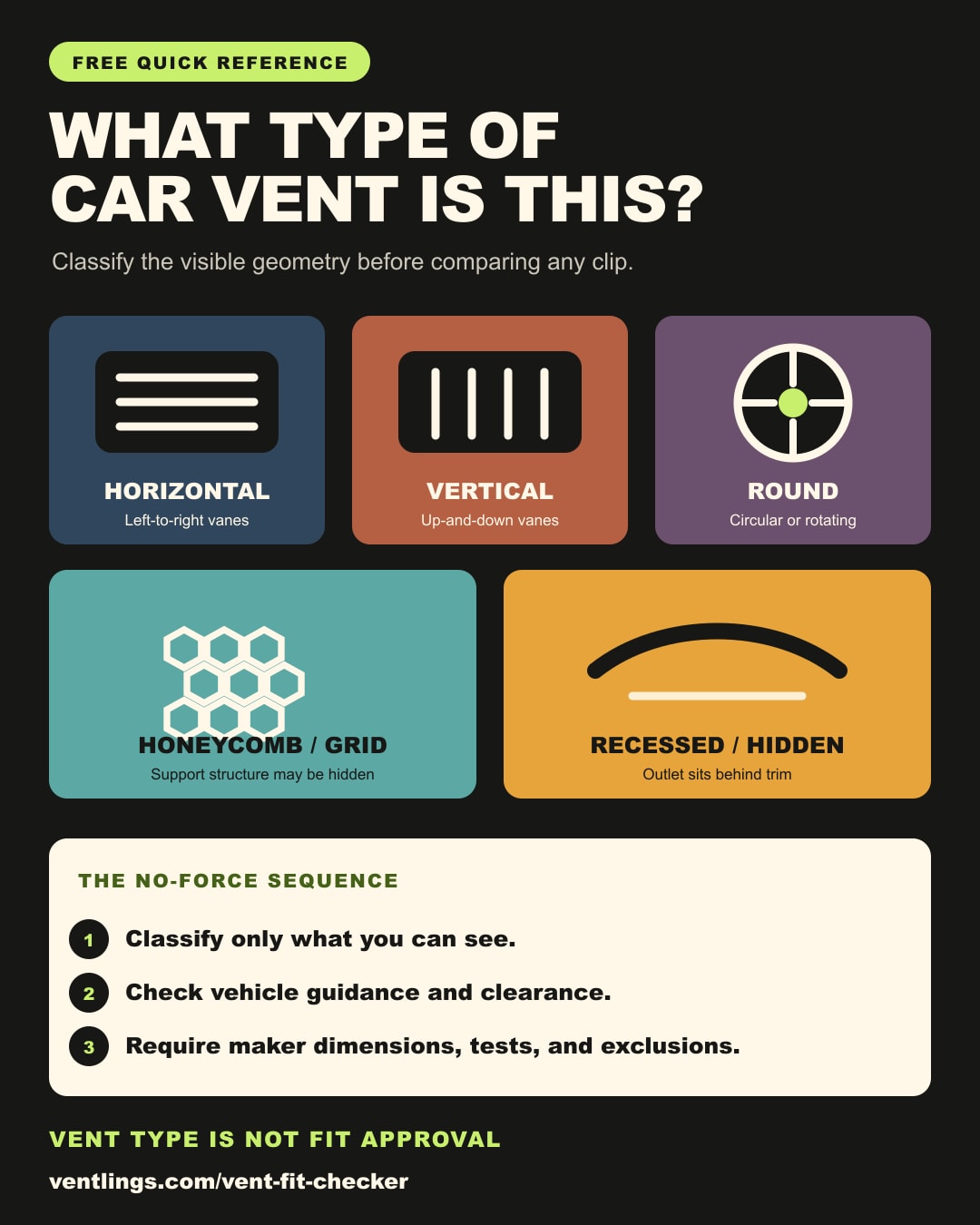
Horizontal slats
Exposed vanes run left to right and usually tilt up or down.
Classify the visible outlet, screen the intended location, and get a cautious next step before comparing any vent-mounted accessory.
Ventlings are still in preproduction. This tool does not claim that any Ventling fits any vehicle or vent style.
These labels are practical visual shorthand, not an automotive standard or a fit result. One outlet can combine more than one feature.
Exposed vanes run left to right and usually tilt up or down.
Exposed vanes run up and down and may move side to side.
Compare vertical and round vent clips →A circular outlet, often with curved vanes or a housing that rotates as a unit.
Compare round and vertical vent clips →Many small openings with no obvious individual vane to clip onto.
Read the honeycomb field guide →The outlet or slats sit behind trim, a grille, or a narrow opening.
Read the hidden-dashboard vent guide →A visible opening does not tell you where a holder can attach. Use these distinctions to ask a seller for the missing evidence before buying.
A blade may sit behind the surrounding trim. The holder body can meet the trim before its prongs reach an attachment point. Ask for the usable reach measured from the holder body, plus a side-view installation image on the same outlet. Extra clip length alone does not establish retention.
Small grille openings are not the same as an exposed blade. If a grille covers the vanes, ask the maker to identify the intended attachment point and the exact vehicle and outlet supported. An adapter shown on one dashboard is not evidence for every honeycomb design.
Separate the blade direction from the holder's permitted orientation. A clip that rotates is not automatically suitable for a curved or moving vane. Ask whether the complete holder can remain in its instructed position while the vent moves normally.
P&G's Febreze Car FAQ identifies slat thickness, vent type and insufficient prong reach as possible fit limits. It describes horizontal and vertical installation for that product, with the adjuster upright or sideways. Its activation instructions say to raise the rear clip to 90 degrees until it snaps into place. These are product-specific instructions; check the current packaging for your exact version. Read the manufacturer's fit and use instructions →
In a firsthand Civic owner discussion, one commenter reports that clips would not pass through the honeycomb openings. That explains a real buying frustration; it does not validate the thread's improvised workarounds. Ventlings has not tested those installations.
| Question | Known from your inspection | Still unknown without product evidence |
|---|---|---|
| Clip reach | Whether the blade sits behind trim or a grille. | Usable prong reach, insertion clearance and intended engagement depth. |
| Attachment point | Whether an exposed blade is visible. | Supported blade thickness and shape, contact surfaces and retention under the complete holder's weight. |
| Orientation | Blade direction and normal outlet movement. | Allowed holder orientation, any rotation limits and clearance throughout that movement. |
| Ventlings compatibility | The character artwork and proposed dock concept. | Finished dimensions, materials, supported vehicles and physical fit-test results. No vehicle compatibility is established. |
“For my exact model year and this outlet, which part does your holder grip? Please send the clip reach and supported blade dimensions, a side-view installation photo, allowed orientation, exclusions and installation/removal instructions. What evidence covers the fully loaded holder?”
Keep compatibility unconfirmed. Do not force a clip through a grille, modify its prongs or wedge it behind trim to create a fit. Compare another product format using its documented placement instructions.
Compare placement requirements →Source review: September 13, 2026. This decision aid combines manufacturer documentation, a clearly labeled owner report and questions to resolve missing evidence. It is not a physical test report.
The reservation form and paid checkout are paused, and this checker does not collect an email or vent type. Dated validation changes are published in the build log.
The tool deliberately stops before product compatibility because that conclusion requires evidence the user cannot create from a visual check alone.
See the 54-path design case study →This checker does not ask for a name, email, vehicle identification number, license plate, or photo. Keep your own notes so you can compare them with a maker's eventual measured fit guidance.
Note the overall outlet shape, whether the visible vanes run horizontally or vertically, and whether a grille covers them.
Record whether individual slats tilt, the whole outlet rotates, or the vent closes, retracts, or moves behind trim.
Look for controls, screens, tabs, trim, sight lines, airbag areas, and defogging outlets near the intended location.
Compare only against published mount dimensions, weight, supported ranges, instructions, retention tests, and exclusions.
See the inspection sequence, mounting questions, fragrance considerations, and Ventlings' current validation matrix.