54 paths, zero fit claims: designing a car vent checker that refuses to guess.
The interface asks three simple questions. The evaluator checks location restrictions first, collapses 54 possible answer sets into six cautious next steps, and never turns visible geometry into compatibility.
The wrong brief would be “tell every visitor whether a clip fits.” A photo of an outlet cannot reveal hidden construction, material strength, available insertion depth, retention under load, or the vehicle maker’s location guidance. The better brief is to make uncertainty visible, give every stop an actionable next step, and publish the exact boundary between observation and evidence.
What “universal” leaves unsaid
The label can fail as compatibility evidence even when a product works on many vents. The missing information is the tested envelope. For example, Logitech’s model-specific guidance describes most slats from 1–5 mm and names circular, deeply recessed, and uniquely shaped exclusions. Belkin’s WIC003 guidance publishes a different model-specific boundary: slats up to 3 mm thick and 20 mm deep, a preference for straight horizontal slats, and a load caveat for vertical slats.
Those numbers are not universal thresholds and should not be transferred to another mount. They demonstrate the form that useful evidence takes: measured limits, named geometry, orientation, carried load, and exclusions. The checker is designed to hand a visitor toward that evidence instead of inventing it.
1. Start with what can be observed
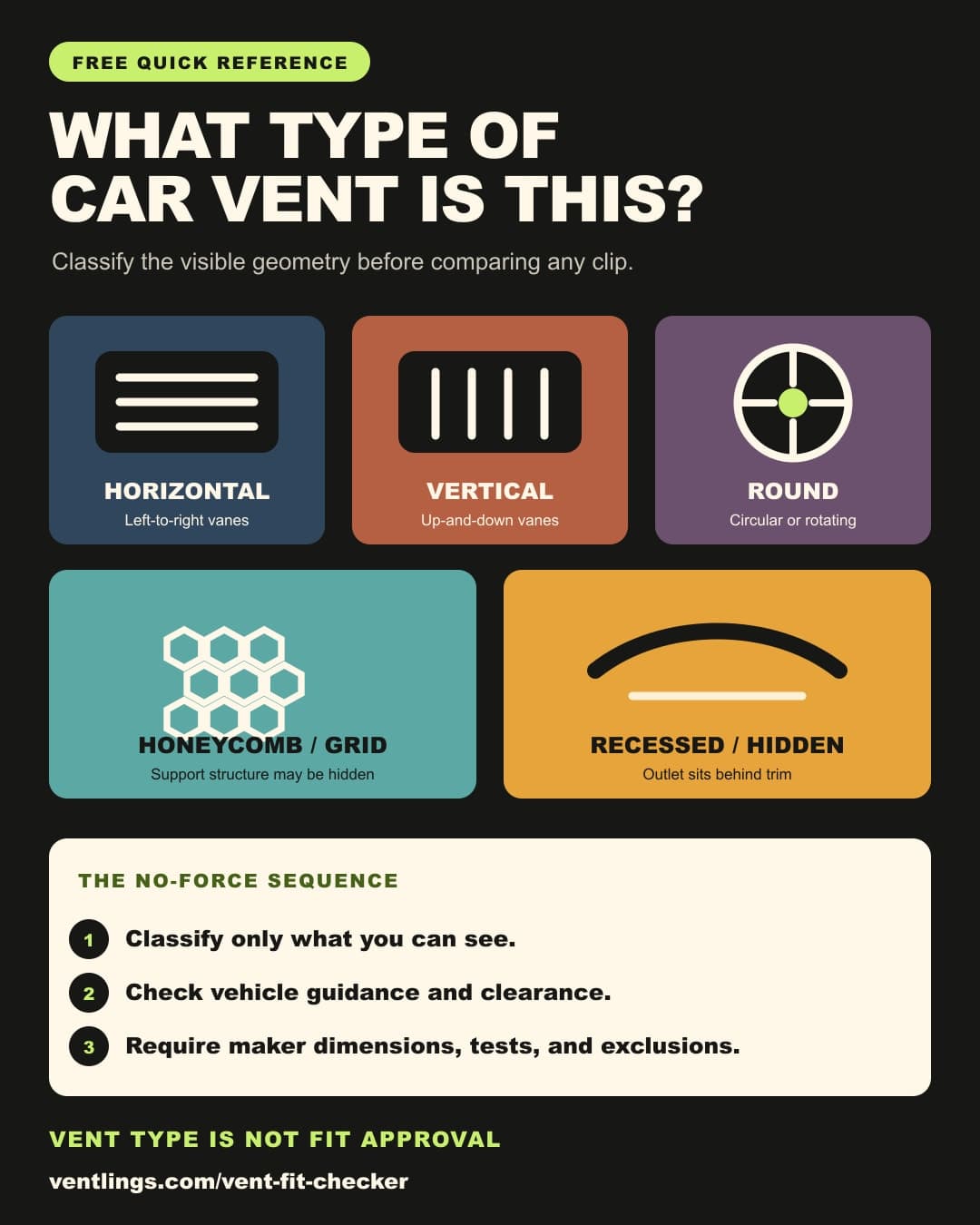
The first answer describes only what is visible at the outlet. It does not identify a vehicle, infer hidden construction, or measure a mount. Five common descriptions and one uncertainty option are available:
Horizontal slats
Exposed vanes run left to right and usually tilt up or down.
Vertical slats
Exposed vanes run up and down and may move side to side.
Round or turbine
A circular outlet, often with curved vanes or a housing that rotates as a unit.
Honeycomb or fixed grid
Many small openings with no obvious individual vane to clip onto.
Recessed, flush, or hidden
The outlet or slats sit behind trim, a grille, or a narrow opening.
Not sure or a combination
The outlet mixes features or does not clearly match one description.
One outlet can combine features—for example, recessed slats behind a decorative grille. In that case, “Not sure or a combination” is more faithful than forcing the observation into a familiar category. The honeycomb field guide, round-versus-vertical guide, and hidden-dashboard guide show why those distinctions matter without claiming fit.
2. Ask in recognition order; decide in risk order
The interface requires one answer in each group. The assessment function receives only those three controlled values:
The form asks about geometry first because it is the easiest observation to recognize. The evaluator intentionally starts somewhere else: a prohibited location or unchecked vehicle instruction must take precedence over a familiar-looking outlet.
- 01Describe visible geometry
- 02Check location guidance
- 03Inspect the visible front edge
- 01Stop at a blocked location
- 02Pause at unclear guidance
- 03Then evaluate geometry and mount visibility
3. Let the model refuse a verdict
Evaluation stops at the first matching condition below. This short-circuit order is important: a later, more permissive observation never cancels an earlier stop or check. The result codes are shown so the method can be audited against recorded aggregate events.
A horizontal or vertical slat reaches compare_after_testing only when the location is checked and clear and an exposed, intact mounting point is visible. Even then, the result says “candidate for future comparison.” It does not say a clip fits.
The location is prohibited or obstructed, so geometry cannot override the stop.
The location has not been cleared against the vehicle maker’s guidance.
The outlet or visible mounting area is too uncertain for a mount comparison.
There is no exposed, intact candidate point at the visible front edge.
Round, honeycomb, or recessed geometry needs a purpose-tested mounting approach.
A straight exposed slat passes the screen, but measured product data is still required.
4. Design the handoff, not the verdict
The checker knows only the three answers a visitor selects. It does not inspect the vehicle manual, verify that an observation is accurate, see behind trim, identify a vehicle by make or model, or compare an actual mount against the outlet.
Visible geometry, location status, and front-edge mounting-point status.
Stop, check, document, require special evidence, or compare later.
Measured interface limits, mass, instructions, permitted geometry, and no-force removal.
Installation, retention, vibration, heat, airflow, movement, and clearance evidence.
Passing the visual screen cannot substitute for that evidence. Park before inspecting, keep controls and safety systems clear, and never insert fingers, tools, rulers, or a test clip to probe an outlet. The full no-force vent-clip guide explains the broader comparison process, and the 10-point evidence checklist turns a maker's public documentation into a reusable review brief.
5. Privacy and event boundaries
The checker does not ask for a name, email address, vehicle identification number, license plate, photo, or free-text description. Its three selections live in the page’s in-memory interface state; the checker does not write those selections to local storage or a Ventlings reservation record. Resetting the form clears that interface state.
Those event properties contain no name, email, VIN, plate, photo, or free text. The surrounding site uses privacy-minded first-party measurement and may retain first-touch campaign attribution separately from checker answers. The current provider, retention, and browser-storage disclosures are documented in the privacy notice.
6. What automated validation covers
As of this methodology version, the decision-module test exercises all 54 input combinations. For every combination it checks that the Ventlings status remains unconfirmed, the title and summary are present, exactly three next steps are returned, and prohibited confirmation language is absent.
Targeted assertions also verify that a blocked location overrides all six vent descriptions, unclear vehicle guidance pauses comparison, round, honeycomb, and recessed outlets require geometry-specific evidence, and horizontal or vertical exposed slats remain candidates only after future mount testing.
7. Five reusable decision-tool rules
Prefer observable inputs
Ask for what a person can describe without tools, probing, or technical vocabulary.
Include “unknown”
An honest uncertainty state is safer and more informative than a forced category.
Order rules by consequence
Let restrictions and missing guidance outrank an answer that merely looks familiar.
Make abstention actionable
Every stop should explain what to document, verify, or avoid next.
Test the finite rule space
Enumerate every combination, then publish what software coverage still cannot prove.
8. Ventlings status and versioning
As of August 24, 2026, Ventlings is an original preproduction concept. There is no production-equivalent dock, published measured fit range, supported vehicle list, or completed retention program. The checker therefore makes no compatibility claim for any Ventling, vehicle, or vent style; every result carries an unconfirmed status.
Material changes to the taxonomy, input options, rule precedence, result codes, event payloads, or evidence status should be reflected in a newly dated methodology version. Follow the public build log for validation progress or read how the proposed reusable system is intended to work.